
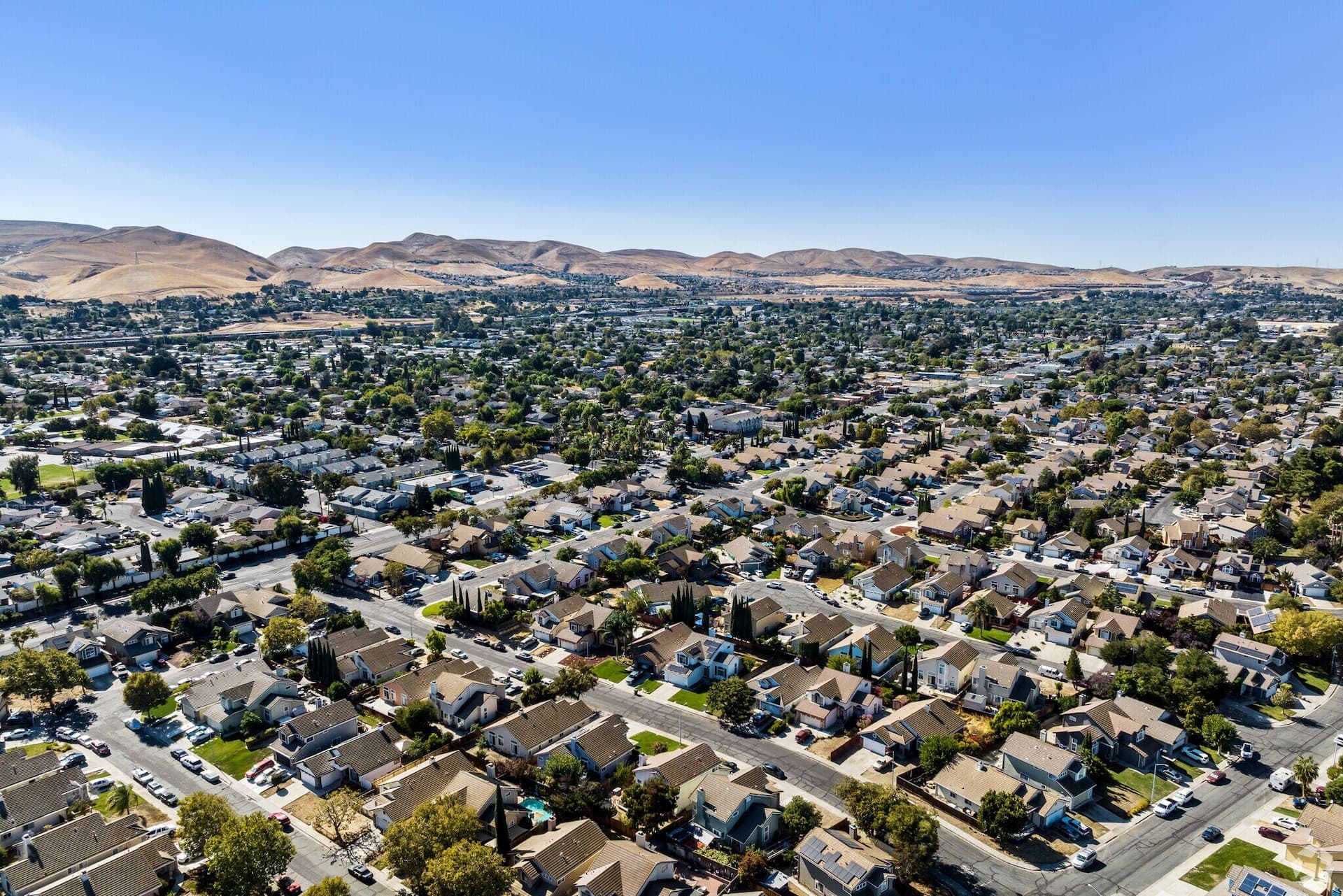
Community comparison
Antioch vs Pittsburg
Quick take
At a glance
The 60-second version of this comparison. Scroll down for the full breakdown.
Pricing
Antioch
$500K–$800K typical. Lone Tree Way corridor commands premium. Newer construction east of Highway 4 reaches mid-$800Ks.
Pittsburg
$480K–$750K typical. Old Town Pittsburg historic district has unique character premium.
Schools
Antioch
Antioch Unified K-12. Quality varies by specific school. Families typically research individual schools.
Pittsburg
Pittsburg Unified K-12. Generally similar reputation; variable by specific school. Pittsburg HS strong sports tradition.
Commute
Antioch
BART eBART direct to SF. Highway 4 substantially widened. 75-90 min commute peak.
Pittsburg
Full BART (faster than eBART) at Pittsburg/Bay Point. More practical for daily SF commuters.
Vibe & character
Antioch
City in transformation. Downtown waterfront revitalized. Lone Tree Way corridor modern shopping.
Pittsburg
More established small-town character. Old Town Pittsburg authentic. Marina district anchors waterfront.
Trade-off highlight: Commute minutes and real monthly housing cost (taxes, Mello-Roos, insurance) usually move decisions more than listing photos—stress-test both against your actual work week and budget.
Pick Antioch if…
- You're betting on Antioch's continued downtown renaissance
- You want newer construction options (Lone Tree Way and beyond)
- Larger square footage matters more than neighborhood polish
- You're attracted to the 'getting better' trajectory
- First-time buying or moving up from a condo
Pick Pittsburg if…
- BART direct (no eBART transfer) matters for your daily commute
- Established neighborhood character appeals more than transformation potential
- Old Town Pittsburg historic feel is what you want
- You value an authentic community over new development polish
- Marina/waterfront access is part of your lifestyle priority
Want more detail?
Explore each community
See photos, full market context, and detailed neighborhood guides for each.
Antioch
BART-connected, value-priced, and one of the most diverse cities in the Bay. Antioch is the workhorse of East County — the largest, oldest, and most diverse city on this side of the hills. Founded as a 19th-century river town, it now stretches from a historic Rivertown waterfront up into the hills above Lone Tree Way, with a wide mix of housing, walkable…
Explore Antioch →Pittsburg
BART, waterfront downtown, and East County's most affordable entry point. Pittsburg has more history than any other city in East County, and you feel it the moment you walk into Old Town. The original waterfront was built by Italian and Portuguese fishing families in the late 1800s, and Railroad Avenue is still lined with old brick storefronts, family-own…
Explore Pittsburg →Antioch and Pittsburg are East County's twin value-tier markets — adjacent BART-accessible cities with similar price points, similar buyer profiles, and surprisingly different community characters. Both anchor the affordability end of East County. Both offer the rare combination of bay views and BART access. But the daily experience of each is distinctly different, and the choice often surprises buyers who assume they're interchangeable.
If you are shopping online from a spreadsheet, these two can look eerily similar: comparable median prices on listing portals, similar commute times if you squint at the map, and overlapping school districts in reputation. Walk the neighborhoods on a Saturday afternoon, though, and the contrast sharpens quickly. Antioch feels like a larger city piecing together a forward-looking waterfront identity. Pittsburg reads smaller, older, and more rooted — the kind of place where neighbors recognize each other at the farmers market and historic downtown still matters to civic pride.
Buyers who tell us they are "open to either" usually have not yet decided whether they want energy spent on transformation or energy spent on continuity. Neither answer is wrong. East County rewards both philosophies — but they lead to different streets, different evening routines, and different emotional contracts with the place you call home.
This guide walks through who tends to land where, what the money buys in each city, how schools and commutes differ in practice (not just on paper), and the lifestyle texture you should expect after move-in day. Along the way we will call out the honest trade-offs: where you gain square footage, where you gain minutes back on BART, and where you need to do block-by-block homework rather than trusting a city-wide label.
Buyer fit
Who tends to pick Antioch — or Pittsburg?
Antioch
Who picks it
Antioch buyers are typically value-conscious first-time homebuyers, families looking to stretch their budget into a larger home, and increasingly, professionals attracted to the downtown waterfront renaissance. Many are migrating from Oakland, Concord, or further west specifically because Antioch offers more square footage per dollar than almost anywhere else in the Bay Area BART system. The city is in active transformation — the Lone Tree Way corridor and downtown waterfront are visibly improving year over year.
We also meet move-up buyers who tried pricier markets first and decided they would rather bank equity in a house that fits their real life — home office, yard for a dog, room for relatives — instead of renting indefinitely closer to the job center. Antioch makes that trade feel survivable: mortgage math that still pencils for dual-income households, neighborhoods where a three-car garage is not an exotic luxury, and enough retail and services that you are not driving twenty minutes for groceries.
What unifies most Antioch buyers is optimism about trajectory. They understand the headlines of past decades, but they are buying what they see happening now — cleaner public spaces, reinvestment along the water, and commercial tenants willing to bet on a growing daytime population. If you want your purchase to ride alongside civic momentum, Antioch feels aligned with that story.
Pittsburg
Who picks it
Pittsburg buyers are similar in profile but often slightly different in priorities. They're value-conscious but tend to prioritize the more established neighborhoods over the developing ones. Pittsburg has older bones than Antioch — more established trees, more genuine downtown history, and slightly tighter community character. Many Pittsburg buyers are second-generation Pittsburg residents or buyers who specifically want the existing neighborhood feel rather than newer development.
Relocation buyers frequently arrive expecting "the same as Antioch but a few minutes north" and instead discover narrower streets, brick buildings that pre-date the latest suburban template, and neighbors who speak about the city in generational terms. Pittsburg rewards buyers who care about continuity — the bakery that survived every economic cycle, the high school game that still fills the stands, the idea that civic identity is something inherited rather than focus-grouped.
None of that demands nostalgia as a personality trait. Plenty of Pittsburg buyers are newcomers who simply prefer human-scale blocks and the quiet confidence of a town that already knows what it is. If you want your weekends to feel local without constant construction noise two doors down, Pittsburg often wins the vibe check even when listing prices look comparable to Antioch on the first pass.
Pricing & schools
What the money buys — and what schools look like
Antioch
Pricing snapshot
Family homes typically $500K–$800K. Strong value for square footage. Lone Tree Way corridor commands a premium over older central Antioch neighborhoods. Newer construction east of Highway 4 reaches mid-$800Ks.
Antioch's pricing story is one of gradients. A fixer on a quiet interior street can still exist as a genuine entry point for buyers who are handy or patient, while turnkey product near new retail or with water glimpses asks meaningfully more. Buyers who think in terms of cost per bedroom should still budget for nuance: Mello-Roos and special assessments appear in some pockets, and insurance conversations deserve the same attention here as anywhere in wildfire-aware California.
Appraisal-conscious shoppers should tour multiple sub-markets before anchoring expectations. The spread between "affordable Antioch" headlines and the homes families actually fight over can be tens of thousands apart — usually explained by condition, schools catchment, freeway adjacency, and lot usability rather than zip code alone.
Pittsburg
Pricing snapshot
Family homes typically $480K–$750K. Pricing varies dramatically by neighborhood — newer Pittsburg developments are similar to Antioch's eastern reaches, while established Pittsburg can be 20-30% lower. The Old Town Pittsburg historic district has unique character premium.
Because Pittsburg's micro-neighborhoods diverge sharply, your best comps are rarely citywide medians. Historic blocks near downtown trade on walkability and charm; postwar streets trade on quiet and trees; newer subdivisions trade on floor plans that match contemporary expectations. Buyers who gravitate toward established Pittsburg sometimes discover surprisingly gentle numbers relative to commuting alternatives closer to the inner Bay — a reflection of perception lag as much as fundamentals.
If you are cross-shopping the two cities strictly on dollars, run every finalist through the same spreadsheet columns: not only list price, but property tax burden, HOA where applicable, estimated maintenance, and realistic commute costs. Pittsburg can win monthly cash flow in one pocket while Antioch wins space in another — the city label alone will not tell you which column moves.
Antioch
Schools
Antioch Unified School District serves K-12. Quality varies by specific school; some are well-regarded, others are weaker. Families typically research individual schools rather than relying on district-wide reputation.
Treat school research as site-specific homework: visit campuses if you can, talk with parents on local forums, and align bell schedules with your work reality. East County families often solve perceived district worries with intentional after-school structure, magnet programs, or private options — but those fixes carry cost and logistics, so bake them into the plan early if education is a primary driver.
The upside for many Antioch buyers is that housing savings can fund tutoring, activities, or future high school choices elsewhere. The downside is that you cannot assume uniformity — two homes a mile apart can feed different elementary experiences. Let your map layer be school boundaries, not city limits.
Pittsburg
Schools
Pittsburg Unified School District K-12. Generally similar reputation to Antioch — variable by specific school. Pittsburg High School has stronger sports tradition and community support than Antioch High.
Extracurricular infrastructure matters as much as test scores for some households — if Friday nights, marching band, or youth league networks are part of your family culture, Pittsburg's high school environment can feel more woven into town life. Still, the same rule applies: tour, ask locals, and read recent parent reviews rather than relying on a five-year-old reputation snapshot.
If you are comparing two finalist addresses across the city line, compare school paths on a student-by-student basis. Siblings, learning differences, and gifted programming needs all change the calculus. The "better district" question is usually the wrong question; the right one is whether this specific pathway fits your kids for the years you plan to stay.
Between two great options?
Take the Neighborhood Quiz
Five quick questions — get instant matches across the communities we cover, including Antioch and Pittsburg, tuned to budget, commute, schools, and vibe.
Take the Neighborhood QuizCommute & daily life
Commute reality and lifestyle texture
Antioch
Commute
BART at Antioch station (eBART) provides direct rail commute to Pittsburg/Bay Point and onward to SF. Highway 4 has been substantially widened. Total commute to SF typically 75-90 minutes peak.
East County commuting is a lifestyle negotiation. Many Antioch residents hybridize: core office days on transit, home-office days without the bridge-tunnel psychological weight. eBART is a genuine gift for linking the eastern cities into the broader system, but it is not interchangeable with the experience of stepping onto a spine line at rush hour — plan seat strategy, connection timing, and how you handle delayed evenings.
Reverse commutes and East Bay job clusters change the story entirely. If your paycheck lives in Concord, Walnut Creek, or San Ramon, Antioch freeway access can feel dramatically easier than social media threads about "San Francisco commute" suggest. Write down your actual weekly map before you judge either city.
Pittsburg
Commute
BART at Pittsburg/Bay Point station (full BART, faster than eBART). For SF commuters, Pittsburg is often more practical than Antioch because the BART connection is direct without an eBART transfer. This is a meaningful daily-life difference.
The transfer minutes add up emotionally as much as mathematically — especially when you are standing on a platform at the end of a long day, watching rain sweep across the parking lot. Buyers who swear they will "only commute twice a week" often discover, eighteen months later, that those two days still deserve dignity.
That said, Pittsburg is not magically short. Peak hour is still peak hour, parking lots fill, and weekend maintenance windows happen. The advantage is structural simplicity on the rail side for many SF-bound riders — and for households splitting destinations, it can be the tie-breaker that justifies a modest price delta.
Antioch
Lifestyle
Antioch is a city in transformation. Downtown waterfront has revitalized retail and dining. Lone Tree Way corridor has modern shopping and chain restaurants. Older neighborhoods retain working-class character. Generally feels 'on the way up.'
Weekend rhythm in Antioch often mixes errand efficiency with outdoor access — Delta proximity, regional shoreline walks, and Mt. Diablo on the horizon when the air is clear. If you want your city to feel visibly different five years after you buy than it did on day one, Antioch delivers that narrative more bluntly than its neighbor.
The trade-off is aesthetic inconsistency in the near term: new investment beside older fabric, growth conversations at city hall, and the occasional construction season. Buyers who need pristine instant neighborhoods sometimes struggle — buyers who accept incremental improvement as part of the bargain often feel at home.
Pittsburg
Lifestyle
Pittsburg has more established small-town character despite being a city. Old Town Pittsburg has authentic historic feel with locally-owned businesses. Marina district anchors the waterfront. Less obviously transforming than Antioch but more genuine community feel.
Evening life here leans toward repeat-your-favorite-spot rather than chasing novelty openings every week. That can read as sleepy if you crave big-city variety — or deeply comforting if you want to recognize your barista and know which night the food truck pod runs.
Water access, Delta breezes, and a slower pedestrian cadence give Pittsburg a seaside-adjacent identity without pretending to be Monterey. If your mental model of "home" includes porch conversations and block parties more than mega-mall variety, Pittsburg rewards that preference honestly.
Decision checklist
Pick Antioch if… — or Pittsburg if…
Lean toward Antioch if:
- You're betting on Antioch's continued downtown renaissance
- You want newer construction options (Lone Tree Way and beyond)
- Larger square footage matters more than neighborhood polish
- You're attracted to the 'getting better' trajectory
- First-time buying or moving up from a condo
Lean toward Pittsburg if:
- BART direct (no eBART transfer) matters for your daily commute
- Established neighborhood character appeals more than transformation potential
- Old Town Pittsburg historic feel is what you want
- You value an authentic community over new development polish
- Marina/waterfront access is part of your lifestyle priority
Honest trade-offs
What nobody should pretend is simple
These two cities are more different than they appear. Antioch is bigger, more spread out, and undergoing more visible change. Pittsburg is smaller, more established, and feels like a community rather than a city.
Both offer remarkable value for Bay Area BART-accessible homeownership. The honest reality: pricing differences are smaller than character differences. You're not really choosing between 'expensive' and 'cheap' — you're choosing between 'transforming' and 'established.'
For commute-driven buyers, Pittsburg's full BART (vs Antioch's eBART) is a meaningful advantage that often gets overlooked. For square-footage-driven buyers, Antioch frequently delivers more home for less money. Match your priority to the right city.
Zoom out one more layer: resale risk, holding timeline, and job flexibility matter as much as today's preference list. A household planning five years in either city should still stress-test the mortgage against rate shifts and career moves; a household planning twenty years might weight school evolution, infrastructure funding, and climate adaptation more heavily. Neither city removes those macro pressures — but the emotional contract you sign with the street you pick absolutely changes how you experience them.
Final thoughts
How we'd break the tie
If you're picking between Antioch and Pittsburg purely for the most home for the money, look closely at both — sometimes Antioch wins on space, sometimes Pittsburg wins on neighborhood quality. If your daily commute on BART is significant, Pittsburg's BART direct typically saves 15-20 minutes per day vs Antioch's eBART, which is meaningful over time. If you specifically want to bet on a city's growth trajectory, Antioch's downtown waterfront is the East County renaissance story to watch.
Before you write an offer, spend money on the experiential diligence: eat dinner downtown in each city after work, drive your commute on a Tuesday, and walk the finalist block at dusk. East County rewards buyers who verify vibes with their own senses — and Antioch vs Pittsburg is one of the clearest case studies of why that effort pays off.
Appraisers, listing agents, and neighbors will all describe these markets with different language — "undervalued," "transitional," "stable." Strip the adjectives and focus on fundamentals you can inspect: sidewalk condition, median days on market for homes like yours, noise contours from Highway 4, and whether evening parking near your shortlisted street feels safe and predictable.
Loan officers in the East Bay have grown skilled at East County files, but any buyer should still review insurance quotations early. Wildfire scoring, brush distance, and retrofit questions can surprise first-timers migrating from denser markets. Getting those answers in escrow rather than at the contingency wire reduces stress for everyone at the table.
If you are relocating from San Francisco or Oakland, calibrate your expectations for heat, summer air quality patterns, and yard maintenance. The trade for space is often more personal outdoor square footage — budget time, tools, and water accordingly. None of that makes one city superior; it simply makes ownership honest.
Finally, remember that the "vs" framing is a coaching tool, not a permanent identity. Plenty of happy homeowners toured both cities, felt torn, and chose based on a single exceptional listing. Use the framework to clarify priorities — then let the right house on the right block break the tie.
- Median Home Price
- $655K
- Population
- 115,000
- School Rating
- 6/10
- Commute to SF
- 70 min
- Commute to Walnut Creek
- 25 min
- Median Home Price
- $585K
- Population
- 76,000
- School Rating
- 6/10
- Commute to SF
- 60 min
- Commute to Walnut Creek
- 25 min
Go deeper
Related guides

Cost of Living
Cost of Living in East County 2026
What it actually costs to live a comfortable life in East County — from a starter home in Antioch to a Discovery Bay waterfront lifestyle.
Read MoreBy the LIEC Team · 10 min read · Apr 1, 2026

Buying
First-Time Homebuyer's Guide to East County
Practical advice tailored to East County's market: financing programs, neighborhoods that work for entry-level buyers, what to expect at every step.
Read MoreBy the LIEC Team · 13 min read · Mar 20, 2026
Free guide
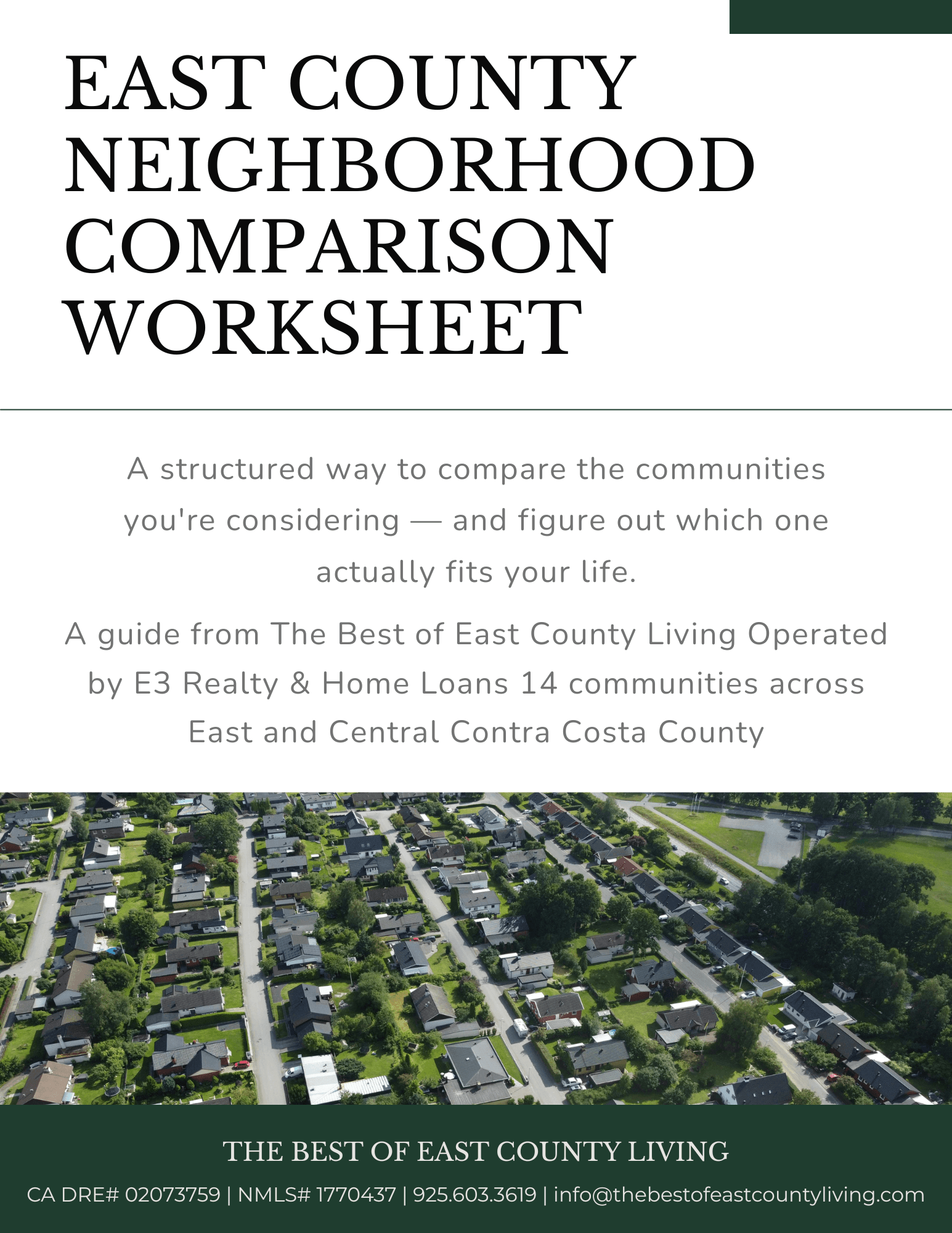
Still weighing two areas? Use our free comparison worksheet
A fillable worksheet to score communities against your priorities — so you can compare apples to apples after touring three or four neighborhoods.
- Priority ranking framework (15 factors)
- 5 community scoring sheets (fillable)
- Weighted summary calculator
Still deciding?
We help East and Central Contra Costa buyers weigh trade-offs every week — no pressure, just local context.