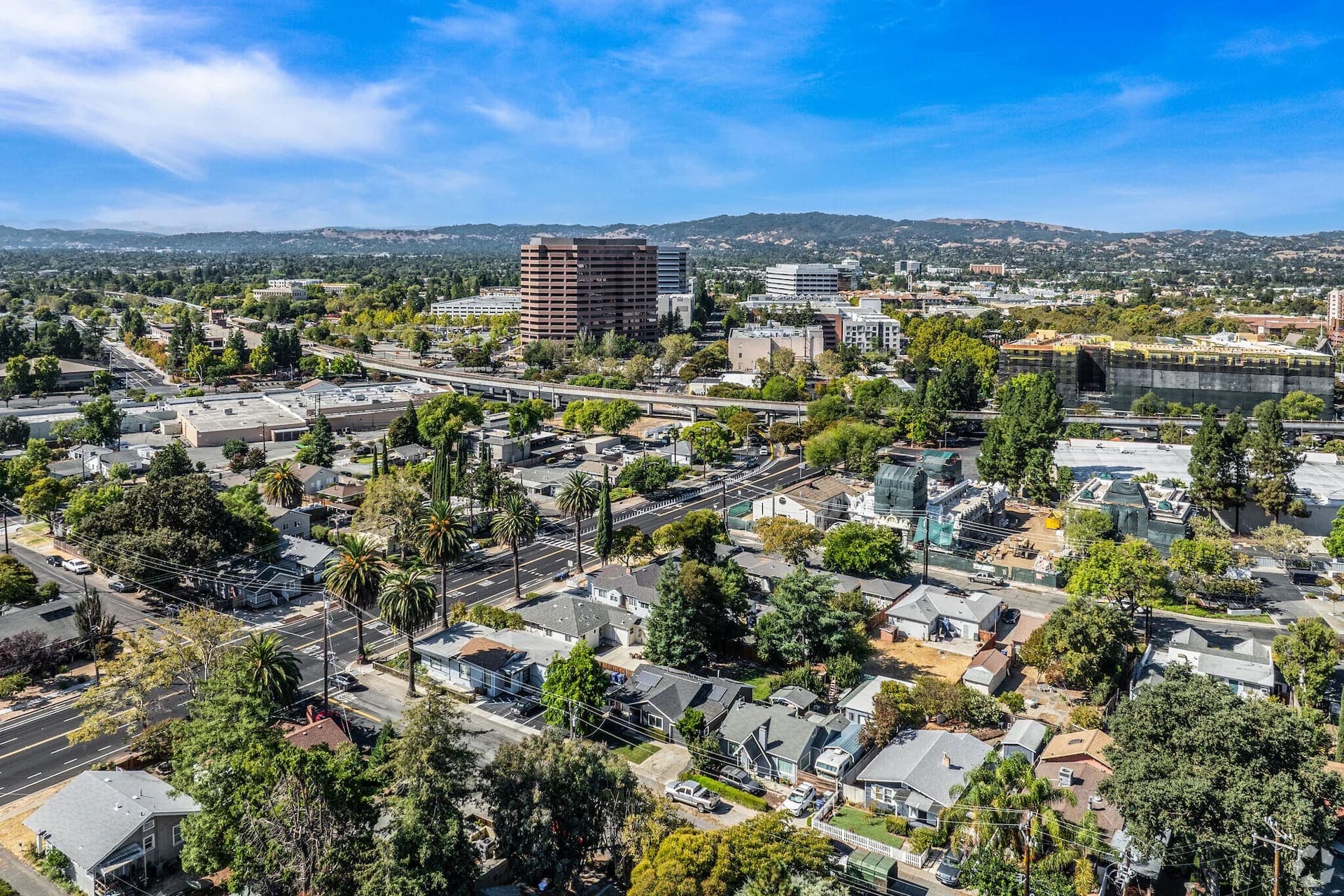
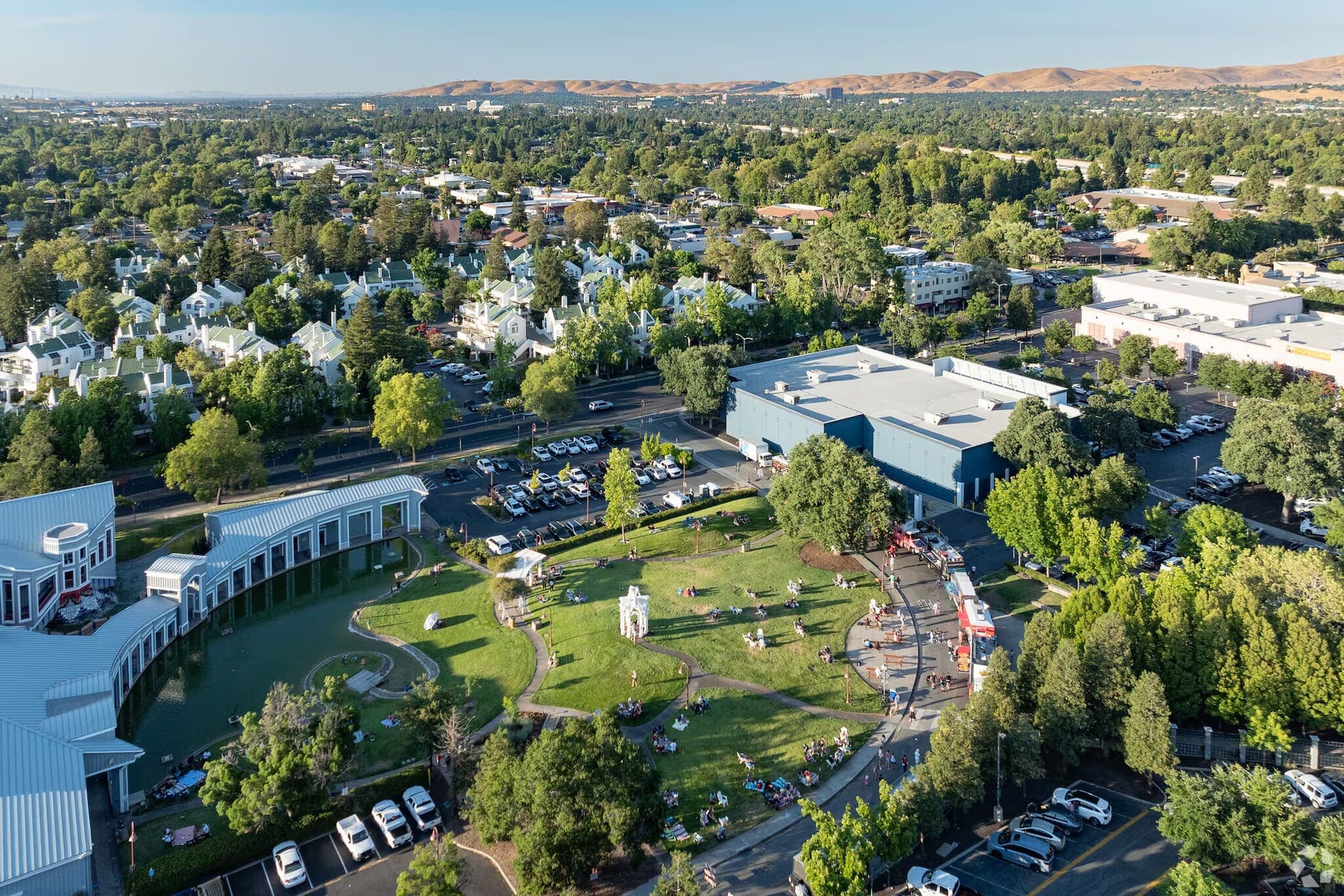
Community comparison
Concord vs Pleasant Hill
Quick take
At a glance
The 60-second version of this comparison. Scroll down for the full breakdown.
Pricing
Concord
$600K–$1.2M typical, with some neighborhoods $1.5M+. Broadest pricing range in Central County.
Pleasant Hill
$900K–$1.4M typical. More uniform pricing reflects more consistent character.
Schools
Concord
Mt. Diablo Unified K-12. Schools vary noticeably by specific neighborhood; research individual schools.
Pleasant Hill
Mt. Diablo Unified same as Concord. Pleasant Hill schools generally consistent. College Park HS well-regarded.
Commute
Concord
Concord BART direct to SF. I-680 access excellent. Many residents work in central Concord.
Pleasant Hill
Pleasant Hill/Contra Costa Centre BART excellent — direct service, close to most Pleasant Hill homes.
Vibe & character
Concord
Largest Central County city. Diverse retail, multiple distinct neighborhoods. Todos Santos Plaza downtown anchor.
Pleasant Hill
Quieter suburban feel. Iron Horse Trail and Heather Farm Park lifestyle assets. Walnut Creek 5 min away.
Trade-off highlight: Commute minutes and real monthly housing cost (taxes, Mello-Roos, insurance) usually move decisions more than listing photos—stress-test both against your actual work week and budget.
Pick Concord if…
- You want neighborhood variety and the ability to find pockets of value
- Specific Concord neighborhoods (Lime Ridge, Crystal Ranch) appeal to you
- Larger city amenities and diversity matter
- You're price-sensitive and willing to research individual neighborhoods
- Concord BART is your daily commute
Pick Pleasant Hill if…
- Consistent suburban character matters more than variety
- Iron Horse Trail and Heather Farm Park are part of your lifestyle
- Pleasant Hill BART access is your commute priority
- You want predictable resale and community character
- Family-oriented community programs are important
Want more detail?
Explore each community
See photos, full market context, and detailed neighborhood guides for each.
Concord
Central Contra Costa's largest city — with everything that comes with it. Concord is the largest city in Contra Costa County and the de facto urban center of Central County. With over 130,000 residents, it offers everything a buyer might want from a mid-size California city: a walkable downtown around Todos Santos Plaza, established neighborhoods, top-tie…
Explore Concord →Pleasant Hill
Family-focused Central County living with strong schools and a walkable downtown. Pleasant Hill is exactly what its name implies: a quiet, family-oriented Central County city with strong schools, established neighborhoods, and a downtown core (around the Pleasant Hill Library and Civic Center) that's increasingly walkable. Sandwiched between Walnut Creek…
Explore Pleasant Hill →Concord and Pleasant Hill are adjacent Central County communities sharing the I-680 corridor and similar suburban character — but they appeal to meaningfully different buyers. Concord is the larger, more economically diverse city with the broadest pricing range in our coverage area. Pleasant Hill is the more established, mid-tier residential community with consistent character and reliable resale.
If you're cross-shopping these two, you're typically weighing scale and variety against polish and consistency.
Central County buyers often begin this comparison from a Walnut Creek open house, then slide east looking for value — and discover Concord and Pleasant Hill offer a middle path: still plugged into the same regional job spine, still benefiting from BART and freeway redundancy, but with housing stock that can feel gentler on the monthly budget if you choose the right pocket. The challenge is that "the right pocket" is a bigger research project in Concord than in Pleasant Hill.
Concord rewards explorers. Pleasant Hill rewards buyers who want the decision to be straightforward after a handful of weekend tours. Neither approach is naive — they are personality matches as much as financial ones. This guide unpacks who thrives where, how pricing spreads actually behave block to block, school realities inside the shared district context, commute tricks locals use, and the lifestyle cadence you should expect once you have signed disclosures and started forwarding mail.
We will be blunt about homework load: Concord can hide gems and pitfalls within the same zip code ; Pleasant Hill tends to wear its quality more evenly on the sleeve. Your patience for due diligence might be the fastest way to choose between them.
Buyer fit
Who tends to pick Concord — or Pleasant Hill?
Concord
Who picks it
Concord buyers value variety — the city has the broadest range of neighborhood types of any Central County community we cover. Some Concord buyers are price-sensitive and find pockets of older Concord that are dramatically below-market for the area. Others are upscale buyers attracted to specific neighborhoods (Lime Ridge, Crystal Ranch, north of Galindo). The unifying factor: buyers who want optionality rather than predictability.
We also see investors and relocation buyers who appreciate Concord's scale — more inventory turns over in a typical quarter, which means more chances for an motivated seller situation, a quirky lot, or a floor plan that suddenly checks every box. If you are the kind of shopper who enjoys iteration, Concord's depth is a feature.
Concord's urban services footprint matters to households that want hospital proximity, major retail clusters, and employer diversity without crossing into the premium pricing of its tonier neighbors. You may sacrifice a curated "everything matches" suburban aesthetic in exchange for genuine city amenities — for many buyers, that swap is an easy yes.
Pleasant Hill
Who picks it
Pleasant Hill buyers want consistent, reliable suburban character without the dramatic neighborhood-to-neighborhood variation of Concord. They're typically families and downsizing seniors who specifically value the established mid-century character, the Iron Horse Trail, Heather Farm Park access, and the consistency of school zones. Pleasant Hill's pricing is more uniform — buyers know what they're getting.
There is relief in predictability when you are moving with children mid-year or managing a distant relocation with limited tour windows. Pleasant Hill often passes the spouse test quickly: tree canopy, orderly blocks, and community programs that feel turnkey. Buyers here frequently say they chose "the boring option that slept well at night" — we mean that as a compliment.
Pleasant Hill also wins for buyers who plan to resell on a defined timeline. Uniformity reduces buyer pool friction later; fewer "love it or hate it" variables show up at listing time. If your life involves periodic promotion-driven moves, that stability can be worth paying for up front.
Pricing & schools
What the money buys — and what schools look like
Concord
Pricing snapshot
Family homes typically $600K–$1.2M, with some neighborhoods reaching $1.5M+. Concord has the broadest range of any Central County community — older central Concord can be $600-700K while north Concord neighborhoods reach above $1.2M.
When agents say Concord is wide, believe them — but also interrogate what "Concord" means on any given listing. Proximity to BART, ridge views, school path, and freeway audibility can swing outcomes more than granite counters. Buyers who love the hunt can find legitimate value; buyers who dislike ambiguity might fatigue before they see the upside.
Renovation math plays a role too. Postwar stock with good bones still appears at numbers that would be unthinkable a few exits south — if you have trade contacts and timeline slack, Concord can be a wealth-building canvas. If you need turnkey predictability, filter ruthlessly for recent systems updates so you are not competing with all-cash flippers on margin.
Pleasant Hill
Pricing snapshot
Family homes typically $900K–$1.4M. More uniform pricing reflects the more consistent character. Pleasant Hill premium is reliable but less variable than Concord's range.
The Pleasant Hill premium is partly structural: buyer pool depth, schools storytelling that requires less translation, and location prestige borrowed from neighboring Walnut Creek without paying full downtown-adjacent numbers. You are buying reduced variance — which shows up in appraisals and in multiple-offer psychology.
Still, "uniform" is not identical. Micro-pockets near busier arterials, corner lots with traffic contours, or homes backing large commercial parcels can lag the neighborhood curve. Walk every finalist twice, at different hours, before you assume Pleasant Hill homogeneity equals automatic sleep-at-night certainty.
Concord
Schools
Mt. Diablo Unified School District K-12. Schools vary noticeably by specific neighborhood — some elementary schools are strong, some are average. Families typically research individual schools rather than relying on district name.
Because Concord spans so much geography, the district label is an umbrella, not a promise. Immersion programs, special education resources, and athletic pipelines differ site to site. If your child thrives with a particular instructional style, align enrollment with that reality early — it can matter more than commute minutes.
Dual-income families should also model before- and after-school logistics: traffic around certain campuses at bell time can reshape what "five miles away" feels like on a Wednesday afternoon.
Pleasant Hill
Schools
Mt. Diablo Unified School District same as Concord. Pleasant Hill schools are generally consistent in quality (better than weakest Concord schools, slightly less variable). College Park High School is well-regarded.
Parents who dread lottery stress or boundary roulette often breathe easier here — not because every classroom is perfect, but because the distribution of outcomes feels narrower. That can be especially valuable if you are balancing multiple kids across grade spans.
Still, do your visits. A great district on paper can clash with a specific child's social needs — and suburban teens care about peer ecosystems as much as scores. Pleasant Hill's stability buys you calmer planning, not a guarantee against adolescence.
Between two great options?
Take the Neighborhood Quiz
Five quick questions — get instant matches across the communities we cover, including Concord and Pleasant Hill, tuned to budget, commute, schools, and vibe.
Take the Neighborhood QuizCommute & daily life
Commute reality and lifestyle texture
Concord
Commute
Concord/Concord BART provides direct rail to SF. I-680 access is excellent. Many Concord residents work at Naval Weapons Station Concord, Concord Pavilion-adjacent employers, or in central Concord retail/medical, which keeps commutes minimal.
If your employer sits along the 680 spine — Walnut Creek, San Ramon, Pleasanton directions — Concord's arterial network offers multiple paths when one chokes. That redundancy matters on the Friday before a holiday weekend when every alternate route becomes a parking lot.
For hybrid San Francisco workers, evaluate parking cost and train consistency alongside drive-days. Concord BART is a strength, but "closer to the station" vs "quieter at night" is a classic trade-off inside the city.
Pleasant Hill
Commute
Pleasant Hill/Contra Costa Centre BART is one of the best BART stations in the area — direct service to SF and much closer to most Pleasant Hill homes than Concord BART is to most Concord homes. Plus excellent I-680 access.
Transit-oriented buyers often discover Pleasant Hill shaves daily friction: easier drops, better synchronized connections for family members heading opposite directions, and a station environment that feels managed and maintained. If your week includes multiple BART days, test the station walk from any address you seriously consider — "close on the map" is not always close at night with groceries.
Car commuters still win here too: you are staged between major job clusters without living at the dead center of the region's worst pinch points. That balance is quietly expensive — hence the premium — but it shows up in quality-of-life spreadsheets as fewer white-knuckle merges per month.
Concord
Lifestyle
Concord is the largest city in Central County. Diverse retail and dining options. Multiple distinct neighborhoods with different characters. Todos Santos Plaza is the recognizable downtown anchor. Generally more 'city' feel than Pleasant Hill.
Civic events scale bigger — concerts, cultural programming, and seasonal happenings draw from a wider population catchment. If you like variety inside a ten-minute drive radius, Concord supplies it without sending you toward bridge toll psychology.
The flip side is sensory diversity: sometimes gritty, sometimes polished, rarely boring. Buyers who need their hometown to feel curated may conflict with that honesty — buyers energized by urban texture will not.
Pleasant Hill
Lifestyle
Pleasant Hill has consistent suburban character. Iron Horse Trail and Heather Farm Park are major lifestyle assets. Quieter feel than Concord. Most retail and dining is shared with Walnut Creek (5 minutes away). Strong family-oriented community programs.
Weekend defaults here skew outdoorsy in a gentle way: bike rides, toddler park rounds, and errands stitched together along predictable routes. You are not chasing novelty every Saturday — you are stacking repeatable joys until they feel like identity.
Food obsessives still eat very well — Walnut Creek's restaurant density is essentially a pantry extension for Pleasant Hill households willing to drive a few exits. The lifestyle bargain is suburban calm with optional urban injection on demand.
Decision checklist
Pick Concord if… — or Pleasant Hill if…
Lean toward Concord if:
- You want neighborhood variety and the ability to find pockets of value
- Specific Concord neighborhoods (Lime Ridge, Crystal Ranch) appeal to you
- Larger city amenities and diversity matter
- You're price-sensitive and willing to research individual neighborhoods
- Concord BART is your daily commute
Lean toward Pleasant Hill if:
- Consistent suburban character matters more than variety
- Iron Horse Trail and Heather Farm Park are part of your lifestyle
- Pleasant Hill BART access is your commute priority
- You want predictable resale and community character
- Family-oriented community programs are important
Honest trade-offs
What nobody should pretend is simple
Concord and Pleasant Hill genuinely overlap on many dimensions — same school district, similar Bay Area access, similar suburban feel. The differences are real but subtle.
Concord's strength: optionality. There are pockets of Concord that are remarkably good value, neighborhoods that are surprisingly upscale, and community variety that Pleasant Hill can't match. The downside: you have to actually research the specific neighborhoods.
Pleasant Hill's strength: consistency. You know what you're getting, school quality is more uniform, and the community character is more cohesive. The downside: less excitement, less variety, less ability to find a 'find.'
For most buyers, the choice comes down to whether you want to do the homework on Concord's varied neighborhoods, or whether you'd rather buy reliable Pleasant Hill quality at a slight premium.
Longer-term, think about household churn: Concord offers more exit paths if life changes — a wider buyer pool can absorb unique homes. Pleasant Hill can make resale smoother for median product precisely because expectations are standardized. Neither is universally better; they optimize for different risk tolerances.
Final thoughts
How we'd break the tie
If you have time to research and like the variety angle, Concord is the smarter choice — you can find genuine value in the right neighborhoods. If you'd rather buy something predictable and move on, Pleasant Hill is the safer pick. Both communities work for similar buyers; the choice often comes down to lifestyle preference rather than affordability.
Schedule tours on the same weekend if you can — compare Saturday traffic patterns, Sunday open-house energy, and how you feel pulling into each driveway at golden hour. Central County rewards buyers who marry spreadsheets with emotional honesty. Concord and Pleasant Hill both pass that test; only you know which answer fits your next chapter.
When national articles talk about "Bay Area suburbs," they flatten nuance that Concord and Pleasant Hill residents live daily. Climate comfort, microclimates on the ridges, and fog behavior can differ subtly between finalists only miles apart. If air quality or outdoor-athletics timing matters to your family, log a month of lived experience before you commit.
Property tax debates and infrastructure bonds affect both cities — watch local measures with the same attention you give HOA docs in a condo tower. Good governance shows up in street repair schedules, storm-drain maintenance during atmospheric rivers, and park staffing.
If elders are part of your household, evaluate medical campus proximity, doorstep accessibility, and whether single-story inventory exists at your price band. Concord's larger footprint can widen choices; Pleasant Hill's predictability can simplify repeat visits to the same providers.
Finally, keep humility about timing the market — interest rates and inventory seasons will move numbers more than neighborhood preference ever could. Pick the community that aligns with your five-year life plan; let the rate environment influence how you structure financing, not whether you choose dignity on the block where you raise kids.
- Median Home Price
- $785K
- Population
- 130,000
- School Rating
- 7/10
- Commute to SF
- 40–55 min
- Commute to Walnut Creek
- 10–15 min
- Median Home Price
- $1.05M
- Population
- 35,000
- School Rating
- 9/10
- Commute to SF
- 45–60 min
- Commute to Walnut Creek
- 5–10 min
Go deeper
Related guides

Cost of Living
Cost of Living in East County 2026
What it actually costs to live a comfortable life in East County — from a starter home in Antioch to a Discovery Bay waterfront lifestyle.
Read MoreBy the LIEC Team · 10 min read · Apr 1, 2026

Buying
First-Time Homebuyer's Guide to East County
Practical advice tailored to East County's market: financing programs, neighborhoods that work for entry-level buyers, what to expect at every step.
Read MoreBy the LIEC Team · 13 min read · Mar 20, 2026
Free guide
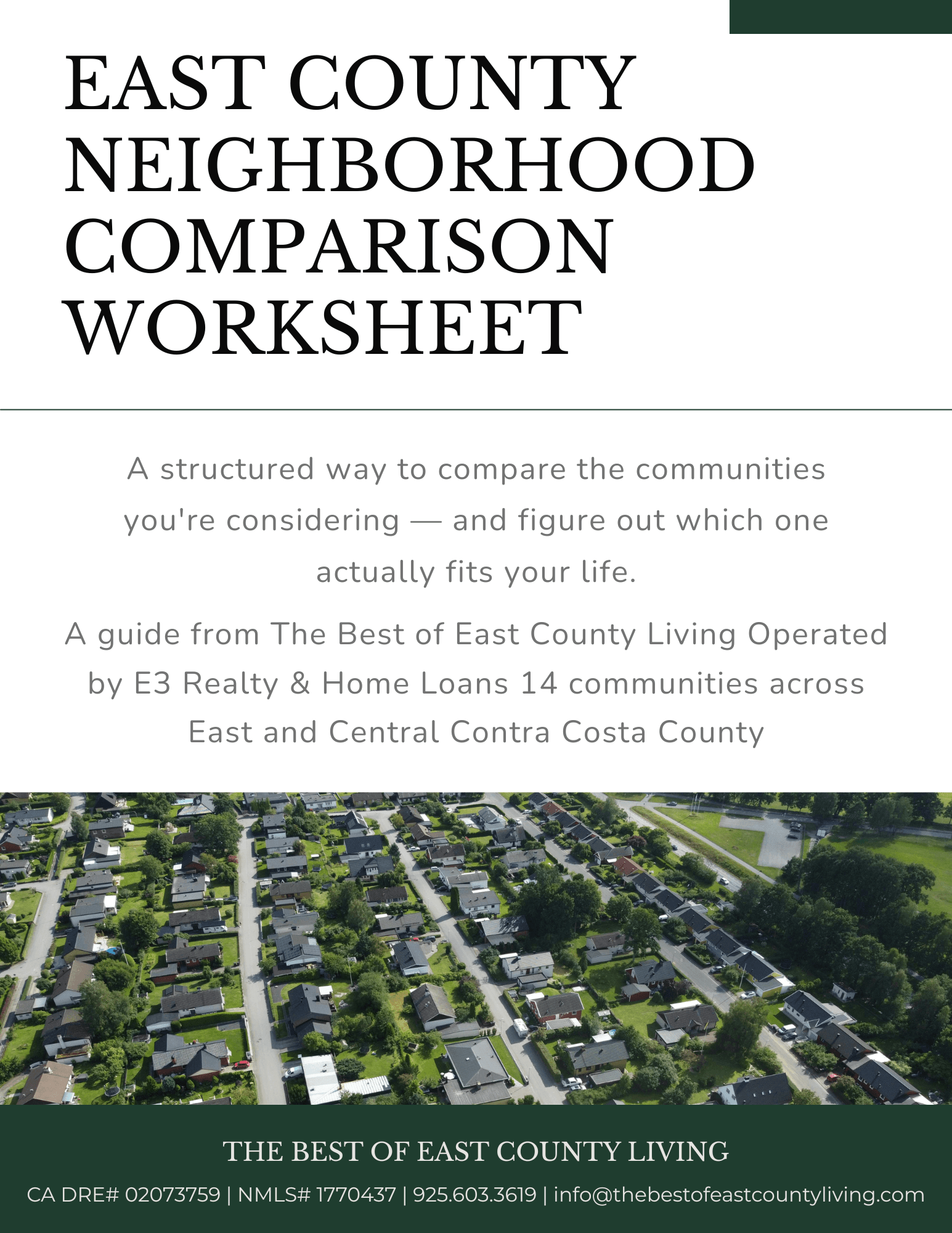
Still weighing two areas? Use our free comparison worksheet
A fillable worksheet to score communities against your priorities — so you can compare apples to apples after touring three or four neighborhoods.
- Priority ranking framework (15 factors)
- 5 community scoring sheets (fillable)
- Weighted summary calculator
Still deciding?
We help East and Central Contra Costa buyers weigh trade-offs every week — no pressure, just local context.