Discovery Bay is the only Bay Area community where "in the backyard" can literally mean "with a private dock and a 35-foot motor yacht." For some buyers that single sentence makes the case. For others it raises questions — about cost, about lifestyle fit, about what daily life looks like in a town that's organized around 1,500 acres of navigable waterway. Both responses are reasonable. Below is what living in Discovery Bay actually feels like, written from the perspective of an agent who's helped a lot of families decide whether it's right for them.
What Makes Discovery Bay Different
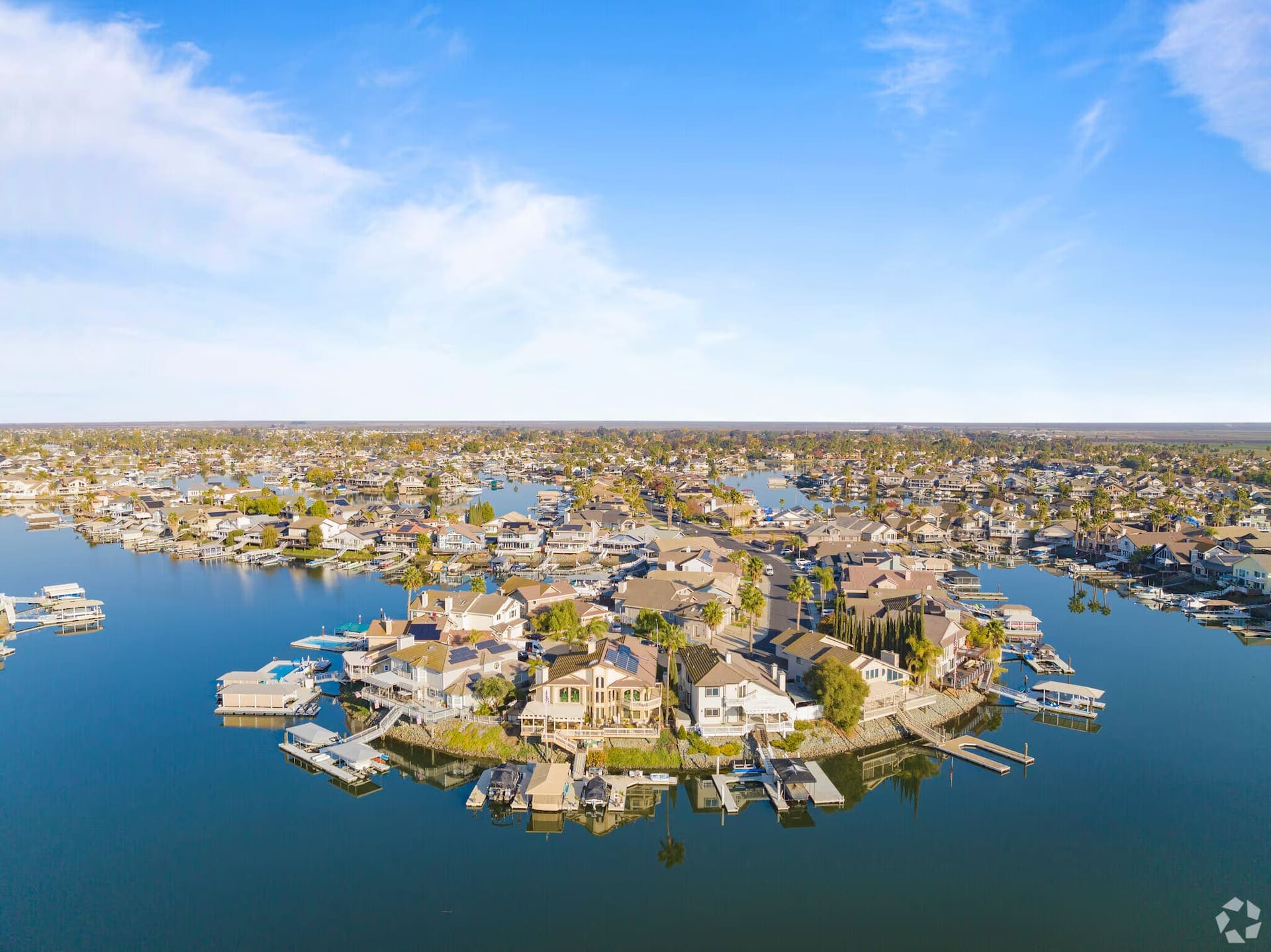
Most Bay Area suburbs are organized around schools, commute corridors, and shopping. Discovery Bay is organized around water. The community sits on the western edge of the Sacramento–San Joaquin Delta — 1,000+ miles of navigable waterway connecting San Francisco Bay to the Sierra foothills. The streets are arranged in long fingers between channels, the back lot lines are seawalls and docks rather than fences, and the social calendar revolves around the marinas, the yacht clubs, and the boating leagues.
This is unusual in the Bay Area. There's no other community in our coverage area where you can fuel up your boat, take it from your private dock to a waterfront restaurant for dinner, and be home before sunset — without ever getting in a car. That single fact is the entire Discovery Bay value proposition. Either it sings to you or it doesn't.
Waterfront vs. Off-Water Homes
Discovery Bay homes break into three rough tiers based on water access:
- True deep-water waterfront with a private dock. The premium product. Direct access to fast water, year-round usable docks, and the highest resale values. Pricing typically $1.2M–$3M+ depending on home size, lot, and dock condition.
- Lagoon or shallow-water waterfront. Still on the water, with a private dock, but limited to smaller boats or non-motorized craft because of depth. Pricing $900K–$1.5M.
- Off-water with community access. Standard subdivision homes inside the Discovery Bay Master Association footprint, with access to community parks, pools, and shared docks. Pricing $700K–$1.1M.
The pricing premium for true waterfront is real and persistent. A 3,000-sqft home on a deep-water lot with an updated dock will routinely sell for $400K–$700K more than the same home on a comparable off-water lot a quarter-mile away. Buyers paying that premium are paying for the lifestyle, not the square footage — and waterfront resale tends to outperform off-water resale through market cycles.
Daily Life on the Water
A typical Discovery Bay weekend rhythm in spring through fall:
- Saturday morning — check the boat, clean the dock, take a coffee out on the water for a couple of hours. The Delta is genuinely one of the country's most underrated boating destinations — Frank's Tract, Mandeville Tip, Tinsley Island, the network of restaurants you can dock at.
- Saturday afternoon — back at the dock, neighbors stop by, an impromptu gathering on someone's deck.
- Sunday — slower pace. Maybe a paddleboard or kayak along the channels, brunch at one of the waterfront restaurants by car, errands in Brentwood.
In winter the rhythm slows but doesn't stop. The Delta stays mostly navigable; foggy mornings have their own appeal; and the boating community uses the slow months for boat maintenance and dock projects.
A reality worth naming: if you're not interested in the water, Discovery Bay's lifestyle delta evaporates. The town has good restaurants, decent shopping nearby, and competent schools — but those are also true of Brentwood, Pleasant Hill, and a dozen other communities. The water is the differentiator.
The Community
Discovery Bay's social fabric is organized through a handful of distinct centers:
- The yacht clubs. Two main private clubs (Discovery Bay Yacht Club and the Delta Yacht Club at the south end), plus the public marinas. Club membership is the fastest way to plug into the community as a new arrival.
- Gated communities and HOAs. Several gated subdivisions inside the broader town with their own amenities (gates, pools, parks). The Lakes, Discovery Bay Country Club, and a few smaller gated tracts.
- The marinas. Discovery Bay Marina, the Lighthouse, and a handful of others. Active social hubs in season.
- Boating leagues. Wakeboarding, sailing, fishing — there's an organized league for most things, and they're the easiest way for kids and adults to meet people.
Demographics skew slightly older than Brentwood — more empty-nesters, more second-home owners, more retirees and pre-retirees. Active families are well-represented but the median age trends 5–10 years higher than Brentwood.
Schools
Discovery Bay's school story is good, not exceptional. The community feeds into Liberty Union High School District for grades 9–12 (Heritage and Liberty High in nearby Brentwood) — same district as Brentwood. For elementary and middle, Discovery Bay is split across Byron Union School District (Discovery Bay Elementary, Timber Point Elementary) and parts of Liberty Union (Excelsior Middle School). Schools are well-regarded; the elementary tier is generally a slight step below Brentwood Union's top schools but solidly in the upper tier of East County.
For families with school-age kids, the practical question is usually: are the schools good enough to support a Discovery Bay decision driven primarily by lifestyle? For most families, the honest answer is yes — strong K–12 outcomes, particularly through Liberty Union for high school.
What Discovery Bay Isn't
Honest tradeoffs:
- Limited retail and downtown. The Boardwalk Marketplace is the main commercial center, with a Safeway, a few shops, and a small cluster of waterfront restaurants. For real shopping, you're driving to Brentwood (15 minutes) or Walnut Creek (45 minutes).
- Commute reality. Discovery Bay sits at the end of Highway 4. There's one road in and one road out, and a major accident on the highway is felt immediately. Most residents are hybrid or remote; full-time SF commutes are challenging.
- Boat ownership has real costs. Insurance, fuel, maintenance, occasional levee assessments, dock repair. Plan for $5K–$15K/year on top of the boat purchase, depending on size and use.
- Community can feel insular. The yacht-club / boating-league social fabric is rich but can feel hard to break into for newcomers. The remedy is intentional — show up, join one league, and you're inside.
Want to talk it through?
Discovery Bay is one of those decisions where the right answer is usually clear within ten minutes of an honest conversation about how you actually spend weekends. We're happy to walk through it.